 |
| Home |
| Water System |
| Sewer System |
| Harbor and Bay |
| School Program |
| About MWRA |
| Doing Business with MWRA |
| Contact MWRA |
Boston Harbor
and Massachusetts Bay
Massachusetts
Water Resources Authority
What's New |
Archive |
July 31,
2001 |
||||||||||||||||||||||
| Mr. Glenn
Haas, Acting Assistant Commissioner Bureau of Resource Protection Department of Environmental Protection 1 Winter Street Boston, MA 02108 |
Ms. Linda
Murphy, Director |
|||||||||||||||||||||
Re: Massachusetts
Water Resources Authority, Permit Number MA0103284 Dear Mr. Haas and Ms. Murphy: On July 30, 2001 MWRA received corrected water column chlorophyll data for the period February 1998 through December 2000. As you will recall, MWRA’s monitoring team reported laboratory error in chlorophyll measurements for this time period (see attached OMSAP information briefing for April 4, 2000). As a result, the monitoring team had to re-calibrate and re-calculate both baseline (pre-outfall) and outfall monitoring (September 2000-December 2000) chlorophyll data for the affected three years. MWRA’s outfall Contingency Plan contains three seasonal thresholds for chlorophyll, and an annual threshold. Calculations of the Contingency Plan baseline threshold values, from data collected from September 1992-September 2000, as well as the ambient monitoring post discharge Fall-Winter values were delayed until the corrected data were received. MWRA has now calculated the Contingency Plan chlorophyll threshold values, which are shown in Table 1. The Fall 2000 average chlorophyll, calculated from the corrected data, was 212 mg/m2, which is greater than the Fall threshold value of 162 mg/m2. Thus, the Fall 2000 chlorophyll seasonal mean exceeded the "Caution Level" threshold in the Contingency Plan, triggering notification of EPA, DEP, OMSAP, and the public. This letter constitutes that notification. MWRA found that the high values for chlorophyll in the fall are independent of the effluent outfall and instead reflect a large-scale region-wide occurrence that began prior to the startup of the outfall tunnel. Furthermore, MWRA found no immediate adverse impacts associated with this chlorophyll threshold exceedance. A threshold exceedance per se does not imply either that an adverse situation exists, or that MWRA discharges are responsible for the threshold exceedance. Rather, the purpose of Contingency Plan thresholds is to flag unusual occurrences in Massachusetts Bay.
The following is a discussion of background information and other observations related to the 2000 fall bloom. Background The amount of chlorophyll (the green pigment in plants) in the water column is a key measurement in MWRA’s outfall ambient monitoring program in Massachusetts and Cape Cod Bays. The concentration of chlorophyll is an indication of how much algae are growing in the water. This is important because of environmental concern about the potential for nutrients in the discharge to cause excess algal growth. A certain level of algae is vital to a healthy marine ecosystem; marine algae are the base of the food web, and are food for many animals in the ocean. However, too much algae can cause depletion of oxygen in the water, or in the sediments (benthos) when dead algae settle to the bottom. Also, the potential for exacerbating nuisance algal blooms, such as red tide, is a concern. In Massachusetts Bay, algal blooms (spurts of growth) typically occur in spring and fall. The spring bloom begins when light levels increase and algae use nutrients plentiful in the water. The bloom declines in summer, as nutrients in the surface layer are used up. In the fall, heavy rains and windstorms mix nutrients from runoff and bottom waters into well-lit surface waters, spurring a second bloom. This normal pattern of algal growth is essential to a healthy marine ecosystem. Generally, large fall blooms would have less potential for a detrimental impact than would an excessively large bloom in the spring. This is because the low light and cold temperatures of winter force a natural end to the fall bloom. Also, because the fall bloom occurs when the water column is well-mixed and exposed to the atmosphere, there is less potential for dissolved oxygen impacts. Fall 2000 observations Although the calculation of precise chlorophyll levels and the corresponding thresholds was delayed, MWRA’s monitoring program had reported a sizeable fall diatom bloom first observed during its September, 2000 monitoring. (See http://www.mwra.state.ma.us/harbor/html/mb092900.htm). Increased algal levels were first noted in early September, before the outfall went on-line. Satellite imagery confirmed that there was a region-wide algal bloom from New Jersey north to the Bay of Fundy. The bloom developed in a south-north direction beginning in August. The monitoring team closely followed the progress of this bloom throughout the fall, winter, and following spring, taking extra chlorophyll measurements in late winter and early spring. Throughout this period there were no unusual elevations of nuisance algal species; the diatoms making up the fall 2000 bloom were common members of the normal coastal plankton community. There were no impacts on dissolved oxygen. In fact, water column dissolved oxygen was somewhat higher than usual. Benthic chlorophyll levels, which would indicate whether large amounts of algae were settling to the bottom, were normal. Benthic respiration, which would indicate if an unusual amount of oxygen was being used if excess algae were being broken down in the sediments, was also normal. Particulate organic carbon, (another indication of biomass) and phytoplankton cell counts, peaked in early September (before the outfall went on-line), remaining at moderate levels through late October, then declining to low winter levels. The fall, 2000 particulate organic carbon levels and phytoplankton abundances were well within the range observed throughout baseline sampling. Baseline and post-outfall averages for chlorophyll for fall are shown in Figure 1. 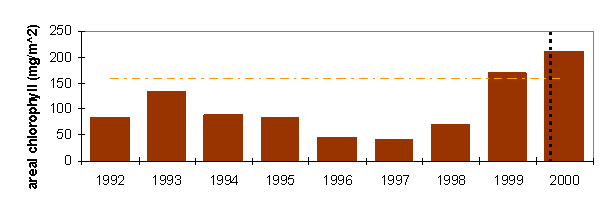
Figure 1. Seasonal outfall nearfield average chlorophyll measurements for fall, 1992-2000. The Fall Seasonal Caution Level threshold is shown as a horizontal dashed line. The Fall chlorophyll levels show an increasing trend over the past four years, and exceeded the threshold in 1999 (before the outfall went on-line) as well as in 2000. Interestingly, satellite imagery shows a trend of increasing fall levels of chlorophyll throughout much of the Gulf of Maine, and south of Cape Cod for the past four years (see Attachment). October images are shown.In summary, all the evidence to date indicates that the fall, 2000 threshold exceedance was part of a region-wide pattern of elevated chlorophyll, independent of the operation of MWRA’s outfall, and that there were no immediate adverse effects of the fall bloom. MWRA will discuss this data further at the next OMSAP meeting. Preliminary data indicate that the 2001 spring nearfield average was 78 mg/m2, well within the spring Contingency Plan threshold of 173 mg/m2./P> Please let me know if any of MWRA's staff can give you additional assistance regarding this notification.
Sincerely,
Michael J. Hornbrook Attachments: Cc:
|
||||||||||||||||||||||
| Many of our reports are in PDF format, which requires Adobe Acrobat Reader®, a free program available from Adobe Systems. |
Updated