WATER


Protecting The Sudbury and Foss Reservoir Watersheds
Massachusetts Water Resources Authority


ON THIS PAGE: Why Protect Them
Map of the Watershed
Emergency Use Scenarios
Public Access Plans
Water Quality Impacts
Sudbury Compliance With Standards
How You Can Help
Whom To Call

WHAT ARE THE SUDBURY AND FOSS RESERVOIRS?

The Sudbury and Foss (Framingham No. 3) Reservoirs are an emergency back-up water supply source for over two million residents of Eastern Massachusetts. The Sudbury Reservoir is located in Southborough and Marlborough and the Foss Reservoir is located in Framingham.

WHAT IS A WATERSHED AND WHY DO WE PROTECT IT?

A watershed is the total area that drains directly across the land and indirectly through the groundwater, to a particular stream, river, pond or reservoir. Precipitation that falls anywhere in the watershed of a given reservoir or stream will eventually end up in that body of water.

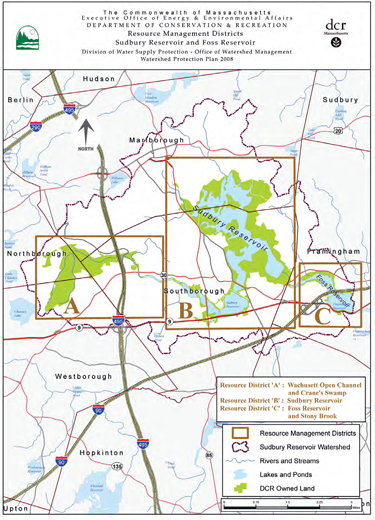
The watershed of the Sudbury and Foss Reservoirs (Sudbury Watershed) is located in Southborough, Marlborough, Framingham, Ashland, Northborough and Westborough. The watershed encompasses 18,241 acres (28.5 square miles) and includes residential, commercial/industrial and forested land, publicly protected lands and other water bodies such as Crystal Pond and North Brook.

We protect watersheds because all activities within them have impacts - some small, some great - on their water quality.

WHY SHOULD WE PROTECT THE SUDBURY AND FOSS RESERVOIRS?

The reservoirs are an important feature in the landscape of the watershed towns. They provide habitat for fish and wildlife as well as recreational opportunities. These resources improve the quality of life and property values in every community.

Although not currently in use, the reservoirs are on standby status and could be activated in the event of an emergency to provide drinking water to people in your community, or in neighboring communities.

Protecting the watershed helps to ensure that the reservoirs are not contaminated, and can be a viable source of drinking water. Watershed protection also helps to preserve the quality of groundwater, the source for local wells.

EMERGENCY SCENARIOS FOR SUDBURY'S UTILIZATION

There are three emergency scenario conditions which would require the use of the Sudbury reservoir:
  1. Wachusett Reservoir is declared non-potable
  2. The inability to convey water from the Wachusett Reservoir to the MWRA system e.g. failure of the Hultman Aqueduct, Sudbury Tunnel, or the City Tunnel.
  3. Serious drought

In these scenarios, the Sudbury Reservoir would either be used as a primary source, a pass through of Wachusett water, or as a supplemental source. The Table below describes each of these conditions.

EMERGENCY USE CONDITION
TYPE OF USE
Primary Use of the Sudbury Reservoir
  1. Wachusett Reservoir water is declared non-potable
  2. Inability to convey water from Wachusett to MWRA system
This would occur if conveyance of water from Wachusett Reservoir was impossible (failure of the Cosgrove Tunnel and Wachusett Aqueduct) or there is a water quality problem in the Wachusett Reservoir which renders the water unfit for potable use.
Pass Through Use of the Sudbury Reservoir
  1. Failure of the Southborough Tunnel
  2. Failure of the Hultman Aqueduct
  3. Failure of the City Tunnel
The reservoir and its transmission system would be used to convey Wachusett water to the MWRA system. In these scenarios Wachusett water would be sent to the Sudbury Reservoir via the Open Channel from the Wachusett Aqueduct and/or the Cosgrove Tunnel and would reenter the MWRA transmission system via the Weston Aqueduct and/or Hultman Aqueduct in Southborough or the Sudbury Aqueduct in Framingham. In this scenario Sudbury Reservoir water would be mixed with Wachusett Reservoir water.
Supplemental Use of the Sudbury Reservoir
  1. Serious drought
In this scenario the Sudbury and Framingham Reservoir would be used to reduce the demand on the Quabbin, Ware and Wachusett water supplies during a serious drought. Sudbury water would be fed into the transport system to augment these supplies.

Back to Top

ARE YOU IN THE SUDBURY WATERSHED?

Find the area where you live, work or shop in relationship to the watershed boundaries identified on the map. As you can see, municipal boundaries do not coincide with watershed boundaries. This is why it's important to cooperate with neighboring communities in protecting your watershed.


Take a look at where these reservoirs fit into the MWRA system:

WATER SYSTEM MAP (117K) Free readers for PDF files and more information
about PDF areavailable from Adobe Systems


PUBLIC ACCESS PLAN: GOALS & OBJECTIVES

The Metropolitan District Commission Division of Watershed Management (MDC DWM) developed a Public Access Plan for the Sudbury Reservoir to provide appropriate management for public use of MDC lands in the Sudbury watershed. The goal of the management plan is to formulate policy and procedures which addresses existing and potential threats to water quality from public access and recreational use of Commission-held lands.

The DWM worked closely with citizen advisory groups and through a public participation process to address community-wide issues of watershed protection and public use of the watershed resources. The goals of the plan are as follows:

  • To determine an acceptable level of secondary, non-water supply, uses of the watershed
  • To improve the understanding among both water supply personnel and recreational users of the special values of the Sudbury watershed.
  • To create solutions to problems which threaten the quality of the Sudbury watershed water while maintaining limited access provisions, where possible.
  • To improve communication between DWM and the general public, city and town governments and other organizations.
  • To improve the quality of existing use of watershed lands in a manner that will reduce impacts to land and water resources, and will promote grater public appreciation of these resources.
  • To continue to document and quantify visitor usage within the Sudbury watershed to assess specific impacts associated therein.

Back to top

WHAT IMPACTS THE RESERVOIRS AND THEIR WATERSHED?

Rainwater and snowmelt that run off the land can carry pollutants such as pathogens, sediments, and nutrients (as described below) which result from various activities. These pollutants eventually make their way into the reservoirs through runoff or groundwater infiltration.

Pathogens: Disease causing bacteria and other organisms which may require special treatment or a boil water order.

Sediments: Particulate matter (e.g. silt and sand) transport pollutants such as pathogens and heavy metals, and decrease water clarity which adversely impacts aquatic life and habitat.

Nutrients: High levels of nutrients (such as phosphorous and nitrogen) cause increased algal growth which limits aquatic life and the use of the reservoir for drinking water.

Back to Top

MASSACHUSETTS CLASS A SURFACE WATER QUALITY STANDARDS AND THE SUDBURY RESERVOIR


PARAMETER
STANDARD
SUDBURY RESERVOIR COMPLIANCE
Dissolved Oxygen (a) shall not be less than 6.0 mg/l unless background conditions are lower;
(b) natural seasonal and daily variations above this level shall be maintained; levels shall not be lowered below 75% of saturation due to a discharge; and site-specific criteria may apply where background levels are lower than specified levels or to the hypoliminion of stratified lakes where the Director determines that designated used are not impaired.
Limited and somewhat outdated data suggests that the reservoir does not always meet this standard in deep waters, typically an indication that sediments may be creating an oxygen demand. The MDC is currently monitoring dissolved oxygen levels within the reservoir.
Temperature (a) not to exceed 68 degrees Farenheit (20 degrees Celsius) in cold water fisheries, nor 83 degrees Farenheit (28.3 degrees Celsius) in warm water fisheries, and the rise in temperature due to a discharge is not to exceed 1.5 degrees Farenheit (0.8 degrees Celsius);
(b) natural seasonal and daily variations shall be maintained.
No indication of any problem meeting temperature demand.
pH pH - shall be in the range of 6.5 - 8.3 standard units but not more than 0.5 units outside of the background range. There is no indication of any problem in meeting pH standards.
Fecal Coliform Not to exceed an arithmetic mean of 20 organisms per 100 ml in any representative set of samples, nor shall 10 percent of the samples exceed 100 organisms per 100ml. Many samples taken previously and currently for total coliform indicate very high counts, suggesting this standard may not be consistently met. Specific areas within the watershed are being targetted for more monitoring and potential implementation of water quality management options.
Solids Water shall be free from floating, suspended and settleable solids in concentrations or combinations that would impair any use assigned to this class, that would cause aesthetically objectionable conditions, or that would impair the benthic biota or degrade the chemical composition of the bottom. There is some indication from past data that this standard may have been sometimes exceeded.
Color and Turbidity Water shall be free from color and turbidity in concentrations or combinations that are aesthetically objectionable or would impair any use assigned to this class. Color appears to be within acceptable ranges, but turbidity limits are probably exceeded when runoff from disturbed areas brings in turbid waters.
Oil and Grease Water shall be free from oil and grease, petrochemicals and other volatile or synthetic organic pollutants. Although there is little data, direct discharges from parking lots and roadways probably now interfere with meeting this standard.
Taste and Odor None other than of natural origin. When the Reservoir was used during the summer months, taste and odor caused by algae were a problem and a source of consumer complaints..

*Compliance of these standards is as indicated in the historical data and on-going MDC/DWM monitoring program of the Sudbury Reservoir.

Back to Top


WHAT YOU CAN DO TO HELP


We all participate in activities that impact the reservoirs and their watershed in some way. We can all help to protect the watershed by implementing suggestions listed below.

SEPTIC
SYSTEMS

ACTIVITY
IMPACT
SUGGESTION
Maintaining a private septic system Systems that are not maintained regularly can build up with solids and clog the leaching field, or leach pollutants into the groundwater and/or reservoir Have system checked annually for solids content. Have tank routinely pumped (average is 2 - 3 years).
Installing or upgrading a septic system Potential pollutants can be eliminated. Your local board of health has developed guidelines for where septic systems can be installed so they don't leach into the reservoir or its tributaries.
HOME
IMPROVE-
MENTS
Building an extension to your house Improper placement and design may increase the impervious surfaces causing more runoff to stormwater systems which can increase pollutant loadings to the reservoir tributaries. Capture increased runoff by installing a roof drain which connects to a dry well.
Building a structure too close to a water body or tributary Disturbance to soil and vegetation increases surface runoff and erosion and can increase sedimentation to the reservoirs. Contact your local zoning board to determine minimum setback requirements.
LANDSCAPING Clearing away natural vegetation and exposing bare soil Disturbance to soil and vegetation increases surface runoff and erosion and can increase sedimentation to the reservoirs. Maintain a natural setting.
Applying chemical fertilizers and pesticides Rainwater washes excess chemicals and nutrients into the ground polluting the ground water and the reservoirs. Use alternatives such as peat moss, compost, bone or fish meal, or use the minimum amount to do the job (e.g. spot applications), or look for natural alternatives.
HOUSEHOLD
ITE MS
Improperly disposing of motor oil, household chemicals, paint or paint thinners on the ground, into septic system, or stormwater system Contaminates surface water and/or groundwater. These chemicals can kill microorganisms and foul your septic tank. Save items for community hazardous waste collection days. Check at your local town hall for scheduled dates.
Using household cleaning products containing phosphates These products enter your leaching field and eventually carry phosphorous to the groundwater and to the reservoir where it increases nutrient levels, causing algal growth. Use a phosphate-free alternative.
PET CARE/
CAR CARE
Improperly disposing of pet wastes Pet waste contributes pathogens to surface water and ground water. Clean up after your pet by disposing of wastes in a proper receptacle.
Car washing on paved surfaces and/or near lakes, streams or drainage ditches Water washes from driveway and street to catch basins and municipal drain systems and carries pollutants to streams, and the reservoirs. Wash car on unpaved surfaces or visit a car wash that recycles.


Local citizens participate in a clean-up effort on the banks of the Sudbury Reservoir; Spring, 1997.


RESERVOIR STEWARDS

There are many groups and agencies working together to protect the watershed. The Metropolitan District Commission (MDC), Massachusetts Water Resources Authority (MWRA), Department of Environmental Protection (DEP), Sudbury Valley Trustees, and the Framingham Advocates for the Sudbury River, as well as community Boards of Health, Conservation Commissions and Planning Boards are taking responsibility to address specific areas of concern.


MDC Division of Watershed Management

The MDC Division of Watershed Management (DWM) was established by the Massachusetts legislature in 1985 to "construct, maintain and operate a system of watersheds, reservoirs, water rights and rights in sources of supply in order to provide sufficient supply of pure water to the Massachusetts Water Resources Authority." The DWM must also conserve and protect these resources in order to ensure the purity of its drinking water supply for future operation.

The intent of isolating the management of the watersheds within a separate agency, was to have a concentrated effort be focused on protection of the water supply sources. The DWM is responsible for management of the watershed lands and surface water of the Quabbin Reservoir, Ware River, Wachusett, Sudbury and Framingham #3 Reservoirs and watersheds. The DWM employs watershed specialists in civil engineering, environmental quality and monitoring analysis, forestry, wildlife, environmental planning, grounds and maintenance, and interpretive services (public education).

Contact MDC at (978)365-3272 if you have any questions or concerns.

MWRA Responsibilities

MWRA is responsible for providing clean, safe drinking water to its customers. To meet this goal cost effectively, MWRA and MDC developed a watershed protection plan for the reservoirs that will support and enhance the MDC's efforts.

Back to Top

CONTACTS

PHONE: (617) 241- 6057
MAIL : Public Information, MWRA, Charlestown Navy Yard, 100 First Avenue, Boston, MA 02129

LOCAL TOWN HALLS
Southborough (508) 485-0710
Marlborough (508) 460-3775
Framingham (508) 620-4864
Ashland (508) 881-0100
Northborough (508) 393-5001
Westborough (508) 366-3020


Back to Water System